




Last Updated: November 2026
A CARFAX report is a vehicle history file assembled from title records, state inspections, service visits and reported accidents. Whether a dealership gives you one free varies, because no law requires it and each report costs the dealer money. That matters more than it sounds. CARFAX estimated in December 2025 that 2.45 million vehicles on US roads carry a rolled-back odometer, up 14% in a year.
AR Motorsports has sold used cars from an indoor showroom in Bay Shore since October 2018. Every vehicle in its inventory includes a free CARFAX report, and each listing shows the owner count.
This article covers who has to provide a report, what the free routes actually are, and what the document does not tell you.
Key Takeaways
1. No law requires a free report: Federal and New York rules govern warranty disclosure, not vehicle history.
2. Reports cost dealers money: Each pull is a real expense, which is why practice varies.
3. CARFAX is not a consumer NMVTIS source: The federal system's data reaches you through other approved providers.
4. Read the timeline, not the summary: Owner count, title brands and mileage progression are the useful parts.
5. A clean report is not a clean car: Unreported work never appears, so it supports an inspection rather than replacing one.
Each point below explains one part of that picture.
What Does a Vehicle History Report Show?
A history report is a timeline built from records other people filed. Title transfers, state inspections, registrations, insurance write-off records and service visits all feed it. The report puts them in date order, so patterns show up.
That structure is what makes it useful. An owner count tells you how often the car changed hands. A title brand flags past damage or an unreliable odometer. A mileage sequence that falls rather than rises is direct evidence of tampering. None of that shows on the car itself.
Do Dealers Have to Give You a Free Report?
No, and it is worth being clear about that. Federal rules require disclosure of a different kind. According to 16 CFR 455 (1985), a dealer must display a Buyers Guide on every used vehicle. It states whether the car comes with a warranty or is sold as-is.
New York adds warranty obligations rather than history obligations. According to the New York Attorney General (2026), the Used Car Lemon Law covers cars driven under 100,000 miles at purchase. The price must also be $1,500 or more. Neither rule mentions vehicle history reports, so providing one is a business decision.
Why Do Some Dealers Charge or Refuse?
Because reports are a per-vehicle cost, and a dealership pulls them on cars it may not sell. A dealer running reports across its whole inventory absorbs that cost on every unit, including the ones that sit. Passing it to the buyer, or simply not offering, is cheaper.
There is a second reason worth naming plainly. A report that shows an accident, several owners or a branded title makes a car harder to sell. A dealer who shows history on every car has picked the harder conversation. That tells you something too.
How Can You Check a Car's History for Free?
Start with the federal system, which most buyers have never heard of. According to NMVTIS (2026), reports from the National Motor Vehicle Title Information System carry the latest reported odometer readings. They also carry the current title, its brand history, and any salvage call by an insurer.
One detail changes how you shop. NMVTIS states that consumers cannot obtain its reports from CARFAX or Experian, because those companies supply that data to dealerships only. You use a separate list of approved providers instead. A dealer-supplied report therefore covers ground a private buyer cannot cover the same way.
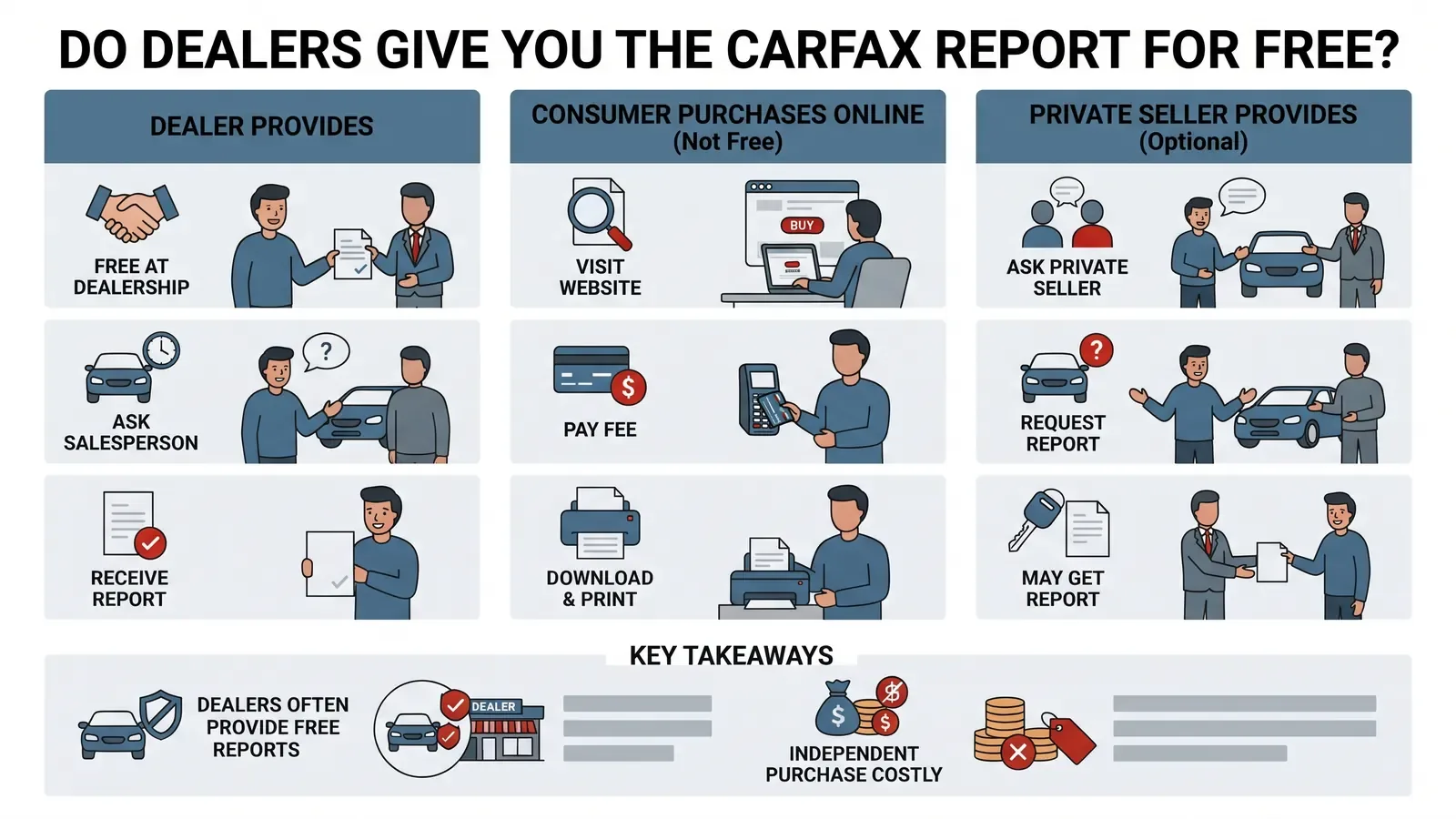
| Route | What you get | Catch |
|---|---|---|
| Dealer-provided CARFAX | Full report at no cost to you | Depends entirely on the dealership |
| NMVTIS approved provider | Title brands, salvage, latest odometer | Not available through CARFAX or Experian |
| Buying a report yourself | Full report on one vehicle | A per-report cost while comparing several cars |
| NY annual inspection record | A dated mileage stamp most years | Only mileage, and gaps if unregistered |
Costs add up when you compare four cars. That is where an included report changes the search.
Read the history before you talk price. That habit protects a budget buyer. AR Motorsports lists its Suffolk County inventory and its Nassau County listings with the owner count shown.
What Should You Read First on the Report?
Go to the mileage timeline before anything else. Read the dated entries in order and check that the figures rise consistently, because a reading that falls is the clearest evidence of a rollback. CARFAX put the average value loss on a flagged vehicle at about $3,300 in December 2025.
Then check the title line for a brand such as salvage, flood or Not Actual Mileage. Those stay with a car for good, and they cut its resale value. Owner count comes third. Several owners in a short span is worth a question, though it proves nothing on its own.
What Does a Vehicle History Report Not Show?
Anything nobody reported, which is a larger category than most buyers assume. Cash repairs at an independent shop leave no record. Nor do accidents settled privately without a claim, or maintenance an owner did in their own driveway. A blank stretch in the timeline is not proof of a quiet life.
That is why a report backs up an inspection rather than replacing one. Use the paperwork for what only records show. Use your eyes and a mechanic for what only the car shows. Neither one stands in for the other. AR Motorsports inspects the cars in its own inventory before listing them.
Frequently Asked Questions
Do dealerships give you the CARFAX for free?
Some do and many do not, because no law requires it and each report is a real cost to the dealership. Practice varies by dealer rather than by state. Where a dealer runs reports across its whole inventory, it absorbs that cost on every unit including the ones that do not sell. Asking whether the report is included, before you visit, is a reasonable question and the answer is itself informative.
Is a dealer legally required to show vehicle history?
No. Federal law requires a Buyers Guide under 16 CFR 455, which discloses whether the car carries a warranty or is sold as-is. New York's Used Car Lemon Law adds mandatory warranty coverage on qualifying vehicles. Neither addresses vehicle history reports. A dealer who provides one is going beyond what the rules require, and a dealer who declines is not breaking any of them.
Can I get a CARFAX report for free myself?
Not directly from CARFAX in most cases. Some listing sites include a report on individual vehicles, and some sellers will send you theirs on request. The federal NMVTIS system is the other route, though NMVTIS states that consumers cannot obtain its reports through CARFAX or Experian, which supply dealerships only. You would use one of the separately approved consumer providers instead.
What is NMVTIS and is it as good as CARFAX?
NMVTIS is the National Motor Vehicle Title Information System, run by the US Department of Justice. Its reports carry the current title and brand history, the latest reported odometer readings and any insurer salvage determination. It is strong on title and salvage data specifically. It is not a like-for-like replacement, because it does not aim to compile the service-visit history that a commercial report assembles.
Does a one-owner car mean it is a better buy?
Not by itself, though it is a mild positive. One long ownership can mean consistent maintenance, or it can mean a car that sat unused and now needs perished rubber and seals replaced. Several owners in quick succession is worth asking about, because cars often change hands after a problem appears. Read the service record alongside the owner count rather than treating either number alone as a verdict.
What red flags should I look for on a report?
Start with any title brand: salvage, flood, junk or Not Actual Mileage. Those are permanent and they change what the car is worth. Then look for a mileage figure that drops between two dated entries, which indicates tampering. Structural or airbag damage in an accident record matters more than a cosmetic claim. Long unexplained gaps are worth a question rather than an assumption.
Is a clean CARFAX report a guarantee?
No, and treating it as one is the common mistake. A report shows what was reported to somebody. Cash repairs at an independent shop, privately settled accidents and owner-performed maintenance never enter the record. A clean report is genuinely reassuring about title status and documented accidents. It is not a substitute for looking underneath the car or having a technician check it.
How much does a CARFAX report cost if I buy one?
Prices change, so check the current figure at the source rather than trusting a number in an article. The point that matters for shopping is that the cost is per report, so it multiplies across a shortlist. Comparing four cars means four purchases. That is the practical reason buyers lean toward dealers who include a report with every vehicle, especially at the budget end.
Does the report show whether the odometer was rolled back?
It can, when the underlying records disagree. Because the report collects dated mileage from registrations, inspections and service visits, a figure that falls over time becomes visible. What no report can show is mileage nobody ever recorded, so a car serviced only by its owner leaves gaps. CARFAX estimated 2.45 million affected vehicles in December 2025, up 14% year over year.
Should I still get an inspection if the report is clean?
Yes, because the two answer different questions. The report covers documented history: title, accidents, owner count and reported mileage. An inspection covers the car's condition today, which no record captures at all. On Long Island it also covers rust from road salt. Salt attacks brake lines and suspension mounting points, and none of that ever appears in a history file. Treat a clean report as a reason to look closely.
Executive Summary
Whether a dealership provides a free CARFAX report varies entirely by dealership, because no rule requires it. Federal law under 16 CFR 455 requires a Buyers Guide disclosing warranty status. New York's Used Car Lemon Law adds warranty coverage on cars bought below 100,000 miles. Neither touches vehicle history. Reports cost dealers money per vehicle, which is why practice differs. The free federal route is NMVTIS, run by the Department of Justice, and it has one important limit. Consumers cannot obtain NMVTIS reports through CARFAX or Experian, which serve dealerships only. On any report, read the dated mileage timeline first, then the title brands, then the owner count. Unreported work never appears, so the document supports an inspection rather than replacing it.
What Should You Do Next?
First, ask whether a vehicle history report is included before you visit. The answer tells you what checking the car will cost you, and something about how the seller operates. Second, read the mileage timeline in date order rather than glancing at the summary badge. Third, treat a clean report as a reason to inspect carefully, not a reason to skip it.
AR Motorsports includes a free CARFAX report with every vehicle and has held a BBB A+ rating since August 2023. You can schedule a test drive and read the full history on any car in stock.
People Also Read
• How Do You Detect Odometer Fraud?
• Curbstoning: Spot Fake Private Sellers
About the Author
Angelo writes for the AR Motorsports team in Bay Shore, New York. The indoor showroom at AR Motorsports has served Suffolk and Nassau County since October 2018. Every vehicle comes with a free CARFAX report, so buyers read the history before they commit. AR Motorsports has held a BBB A+ rating since August 2023. The team works with buyers across every credit profile.
Expertise: Used Vehicle Sales, Vehicle History Reporting, Auto Financing, Trade-In and Vehicle Appraisal, Long Island Used Car Market
Connect: Facebook
Disclaimer: This article is for general information only and is not financial, legal, or tax advice. Vehicle availability, pricing, and terms change without notice. Financing is arranged through third-party lenders and is subject to credit approval, and not all applicants qualify. Vehicle history information comes from third-party reports, including CARFAX, and AR Motorsports does not guarantee that any report is complete. Confirm current details with AR Motorsports before making a purchase decision.