




Last Updated: October 2026
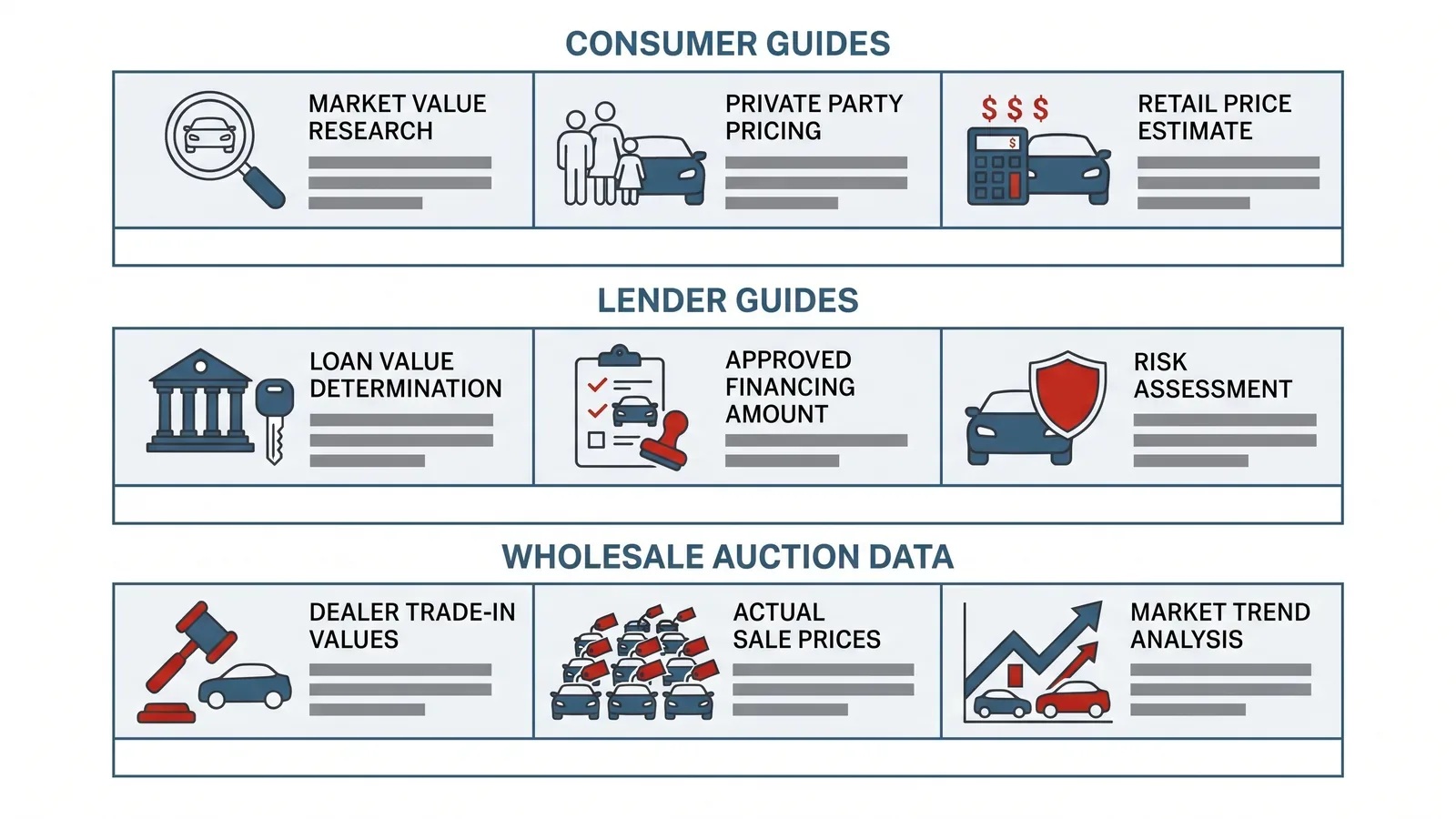
A Kelley Blue Book value and a NADA value are two separate published estimates of what a used car is worth. Two different companies produce them, using two different methods. Kelley Blue Book draws heavily on asking prices and consumer-entered condition. NADA, now J.D. Power Values, leans on dealer transaction data. That difference is why the same car can show a $2,000 spread between the two guides on the same afternoon.
AR Motorsports has bought and sold used cars in Bay Shore since October 2018. It stocks cars from under $10,000, where a $2,000 valuation gap is not a rounding error.
This article explains what each guide measures and which figure predicts a real offer.
Key Takeaways
- NADA is now J.D. Power: J.D. Power acquired the NADA Used Car Guide division and renamed it. The methodology continued; the name changed.
- They measure different things: Kelley Blue Book weights asking prices and self-reported condition. J.D. Power weights completed dealer transactions.
- Neither is a wholesale number: Dealers price trade-ins from Black Book and the Manheim Market Report, neither available to the public.
- Condition is where consumers overestimate: Most sellers rate their car a grade higher than a dealer will, which explains much of the gap.
- A written offer beats any book value: Published estimates are a starting range, not a price. Only a written offer on your VIN is real.
Each deserves unpacking: the differences are methodological, not one guide being wrong.
What Is Kelley Blue Book Value?
Kelley Blue Book value is a published estimate of what a vehicle should sell for. It splits into separate figures for trade-in, private party sale and dealer retail. It also publishes a Fair Market Range and a Fair Purchase Price. Both describe the band most buyers in an area actually pay, rather than a single number.
Where the figure comes from matters more than the figure itself. Kelley Blue Book aggregates a large volume of listing and asking-price data, alongside condition ratings that owners enter themselves. Both inputs carry a bias in the same direction. An asking price is what a seller hopes to get, not what anyone paid, and self-rated condition is almost always generous.
What Is a NADA Value in 2026?
A NADA value is a J.D. Power value. According to J.D. Power Valuation Services (2015), it acquired the NADA Used Car Guide division that year. It added NADAguides.com in 2018. The guidebook name has since changed from NADA Used Car Guide to J.D. Power. If a lender, insurer or credit union quotes you a NADA number today, they are quoting J.D. Power.
That matters practically, not just as trivia. Many banks and credit unions still write NADA into their lending policies. The figure that decides your loan amount may come from J.D. Power under an older label. J.D. Power's data leans on completed dealer transactions rather than asking prices. That is why its numbers often land below Kelley Blue Book on the same car.
Why Do KBB and NADA Values Differ?
They differ because they are built from different evidence. Kelley Blue Book weights what cars are listed for. J.D. Power weights what they sold for. In a rising market, asking prices lead and transaction data lags, so Kelley Blue Book reads higher. In a falling market that inverts.
Three other factors widen the gap. Data lag means neither guide reflects last week's market. Consumer bias inflates condition inputs on the guide that accepts them. Each company also smooths regional variation differently. A car in Suffolk County and the same car in Buffalo can carry one published value despite different local demand.
| What it measures | Kelley Blue Book | J.D. Power (formerly NADA) | Black Book / Manheim |
|---|---|---|---|
| Main input | Asking prices | Completed dealer transactions | Wholesale auction results |
| Condition rating | Entered by the owner | Standardized bands | Inspected at auction |
| Public access | Yes, free | Partly, some licensed | No, trade only |
| Typical use | Consumer research | Lender and insurer | Dealer trade-in pricing |
| Tends to read | Higher in a rising market | Closer to transactions | Lowest of the three |
The pattern is the point: the guides consumers see are not the guides dealers price from.
Which Value Do Dealers Actually Use?
Dealers price trade-ins from wholesale data, not from either consumer guide. The two standard tools are the National Auto Research Black Book and the Manheim Market Report, neither available to the public. Both track what vehicles actually sold for at auction, with condition assessed by a third party rather than the owner.
This is the common friction in a trade-in conversation. A seller arrives with a retail figure and hears an offer built from wholesale comparables. Both can be defensible at once. Published guides are a starting range, so an offer on your own VIN beats any estimate.
Want a real number rather than a range? AR Motorsports buys cars from the public through We Buy Cars. Compare its Suffolk County stock and listings under $10,000 against the guides.
Is Kelley Blue Book Accurate?
Kelley Blue Book is accurate as a range and unreliable as a single price. It draws on a large dataset and reflects the general neighborhood of a car's worth. What it cannot know is the condition, service history and title status of your car. That is where most of the money moves.
Two adjustments close most of the gap. First, rate condition one grade lower than instinct suggests, because that is usually where a professional appraisal lands. Second, look at the trade-in figure rather than the private-party figure when talking to a dealer, since those are different transactions with different costs attached.
How Should You Use Both Guides?
Use them as bookends. Pull the Kelley Blue Book figure and the J.D. Power figure. Treat the space between them as the plausible range. Expect a wholesale offer at or below the lower end. If a dealer offer falls well under both, ask which data source produced it and what condition grade was applied.
Then check the things the guides cannot see. A clean vehicle history report supports the top of the range. A reported accident, an inconsistent odometer reading or a branded title pulls a car below any published number, regardless of what the guide says. Every AR Motorsports vehicle includes a free CARFAX report so that history is on the table before price is discussed.
Does Warranty Status Change What a Car Is Worth?
Yes, and it is often overlooked. A used car sold with warranty coverage is worth more than the same car sold as-is. Published book values do not distinguish between the two. According to 16 CFR Part 455 (1985), every dealer must display a Buyers Guide. It states whether a warranty applies or the car is sold as-is.
In New York the picture is stronger than the federal minimum. According to the New York Attorney General (2026), the Used Car Lemon Law sets coverage by mileage band. Cars from 18,001 to 36,000 miles get 90 days or 4,000 miles. Up to 79,999 miles it is 60 days or 3,000 miles. Up to 100,000 miles it is 30 days or 1,000 miles. A car carrying that coverage is a different proposition from one that does not.
Frequently Asked Questions
Is NADA or Kelley Blue Book more accurate?
Neither is uniformly more accurate, because they answer slightly different questions. J.D. Power, formerly NADA, tracks completed transactions more closely, which is why lenders commonly use it. Kelley Blue Book reflects asking prices and consumer-entered condition. For predicting what a dealer will actually offer, J.D. Power usually lands closer, though wholesale auction data lands closer still. Use both as the edges of a range rather than picking a winner.
Why is my NADA value higher than my KBB value?
Direction varies with the market rather than being fixed. In a falling market, transaction-based figures can sit above listing-based ones because asking prices have not adjusted yet. In a rising market the opposite is common. Condition grading also differs between the two, and a single grade of difference can move a figure by several hundred dollars on an older vehicle.
What is the Kelley Blue Book Fair Market Range?
The Fair Market Range is a band rather than a single figure, describing what most buyers in your area are paying for a comparable vehicle. It is more useful than a point estimate because real transactions cluster in a range. Treat the bottom of the band as your realistic expectation when trading in, and the top as achievable only on a clean, well-documented car.
Do dealers care about Kelley Blue Book value?
Dealers are aware of it and price from other data. Trade-in offers come from wholesale sources like Black Book and the Manheim Market Report, which reflect auction results rather than listings. That is not a dismissal of Kelley Blue Book. It is a different question, because a dealer is estimating what the car will bring at wholesale, not what a retail buyer might pay.
What is Black Book and can I access it?
Black Book is a wholesale valuation service published by National Auto Research and used by dealers, lenders and auctions. It is not available to the public, so you cannot look your own car up in it. It tracks vehicles sold at auction, with condition assessed by inspectors rather than by owners. That is why its figures sit below the consumer guides and closer to the offer you will be handed.
Does mileage or condition matter more to value?
Condition usually moves the number further on an older, higher-mileage car, because vehicles in that band already carry the mileage the market expects. Two cars with identical odometer readings can differ by more than a thousand dollars on service history, tire and brake life, and body condition. Condition is precisely the variable published guides handle least well, since they rely on a seller's own description of it.
How does a vehicle history report affect value?
A clean report supports the upper end of any published range, while a reported accident or a title brand pulls a car below it. History also affects how easily a car sells, not only its price, because some buyers will not consider one with an accident on record. Reading the report before you negotiate means the number you argue for and the evidence behind it agree.
Should I trust an online instant cash offer?
Treat it as a starting figure subject to inspection, not a commitment. Online offers are generated from the information you type in, so they carry the same self-reported condition problem as the consumer guides. The number that matters is the written offer that follows. That comes after someone has examined the car, read the history report and verified the odometer against it.
Why do banks use NADA values for loans?
Lenders want a figure tied to transactions rather than to asking prices, because it determines their exposure if they have to repossess and resell. Many lending policies were written when the guide was called NADA and still use that language, even though the values now come from J.D. Power. Ask your lender which guide and which condition grade they applied.
What is the best way to find out what my car is really worth?
Pull both published figures to establish a range, then get a written offer against your specific Vehicle Identification Number after an inspection. That seventeen-character code is unique to your car, so the offer applies to it rather than to an average of similar ones. The written offer is the only number you can act on, because it accounts for the condition and history no published guide can see.
Executive Summary
Kelley Blue Book and NADA values differ because they rest on different evidence. One weights asking prices and owner-rated condition. The other weights completed dealer transactions. The NADA Used Car Guide is now published as J.D. Power, so a NADA quote today is a J.D. Power quote. That matters because many lenders still use the older name. Neither figure is wholesale: dealers price trade-ins from Black Book and the Manheim Market Report, which the public cannot access. Warranty status and history move real value in ways no guide captures. Use both as a range, then get a written offer.
What Should You Do Next?
Start by pulling both the Kelley Blue Book and J.D. Power figures for your exact year, trim and mileage. Note the spread. Next, rate the condition one grade lower than your instinct and see how far the number moves. Finally, read the vehicle history report before discussing price.
AR Motorsports includes a free CARFAX report with every vehicle and has held a BBB A+ rating since August 2023. You can schedule a test drive and compare a written figure against whatever the guides told you.
People Also Read
About the Author
Angelo writes for the AR Motorsports team in Bay Shore, New York. The indoor showroom at AR Motorsports has served Suffolk and Nassau County since October 2018. Every vehicle comes with a free CARFAX report, so buyers read the history before they commit. AR Motorsports has held a BBB A+ rating since August 2023. The team works with buyers across every credit profile.
Expertise: Used Vehicle Sales, Vehicle History Reporting, Auto Financing, Trade-In and Vehicle Appraisal, Long Island Used Car Market
Connect: Facebook
Disclaimer: This article is for general information only and is not financial, legal, or tax advice. Vehicle availability, pricing, and terms change without notice. Financing is arranged through third-party lenders and is subject to credit approval, and not all applicants qualify. Vehicle history information comes from third-party reports, including CARFAX, and AR Motorsports does not guarantee that any report is complete. Confirm current details with AR Motorsports before making a purchase decision.