


Last Updated: November 2026
A dealer doc fee is the charge a dealership adds for preparing the paperwork that registers and titles your vehicle. New York regulation caps it at $175, which makes this one of the few car-buying numbers with a hard legal answer. Most states set no cap at all, so advice written for a national audience will not tell you what your own buyer's order should say.
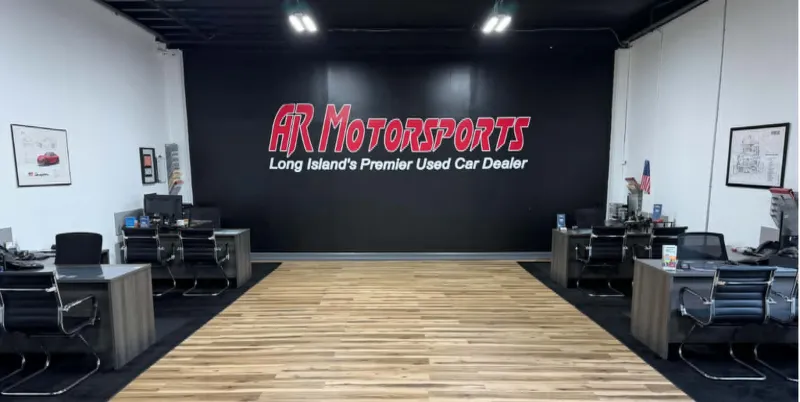
AR Motorsports has sold used cars from an indoor showroom in Bay Shore since October 2018. It stocks cars from under $10,000, where $175 is a real share of the total.
This article covers what the cap actually says, what makes a fee legally reasonable, and the condition most buyers never check.
Key Takeaways
1. The cap is $175: Set by 15 NYCRR 78.19 for assisting with registration or title.
2. Plates have their own $5 cap: A separate limit applies to special or distinctive plates.
3. The fee is conditional: It applies where the dealer actually files the paperwork for you.
4. At or under $175 it is untaxed: Above the permitted amount, that presumption no longer holds.
5. A capped fee is not the risk: Uncapped reconditioning and prep lines are where the money moves.
Each point gives you something specific to check on the order.
What Is a Dealer Doc Fee?
A doc fee pays the dealership for handling your registration and title paperwork with the DMV. Someone has to complete the forms, submit them and collect the plates, and the fee covers that administrative work. It is not a government charge, even though it exists because of a government process.
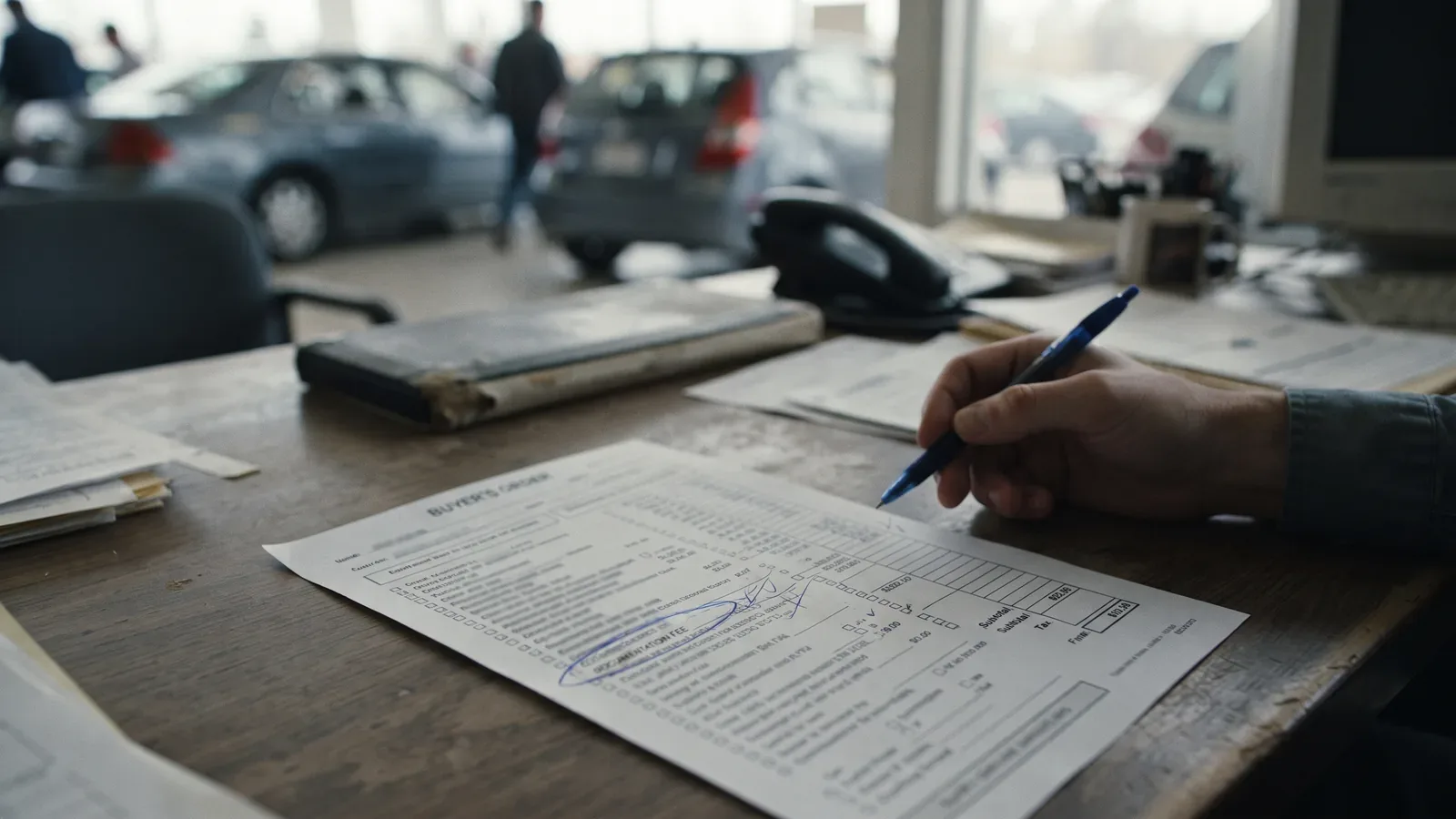
That distinction matters when you read the buyer's order. Sales tax, title and registration are amounts the dealer collects and forwards. The doc fee is money the dealership keeps, which is why it is regulated rather than fixed.
Is the Doc Fee Capped in New York?
Yes, and the cap is specific. According to 15 NYCRR 78.19 (2021), the fee for registration or title assistance "may not exceed $175." That regulation took effect in August 2021.
A second cap sits alongside it and almost nobody mentions it. The same section limits the fee for special or distinctive plates. That one "may not exceed $5." If a vanity plate charge on your order reads $40, ask about it.
What Makes a Doc Fee Legally Reasonable?
The tax code answers this, and it uses the same threshold. According to New York Publication 838 (2012), a doc fee is untaxed where it is "separately stated and reasonable." It then defines the test. The fee is "presumed reasonable if the amount is equal to or less than the amount permitted under" DMV rules.
So "reasonable" has a working definition rather than a vibe. At or below $175, separately stated, the fee is both permitted and presumed reasonable. Above that figure a dealer has left the safe harbor in two separate bodies of rules at once.
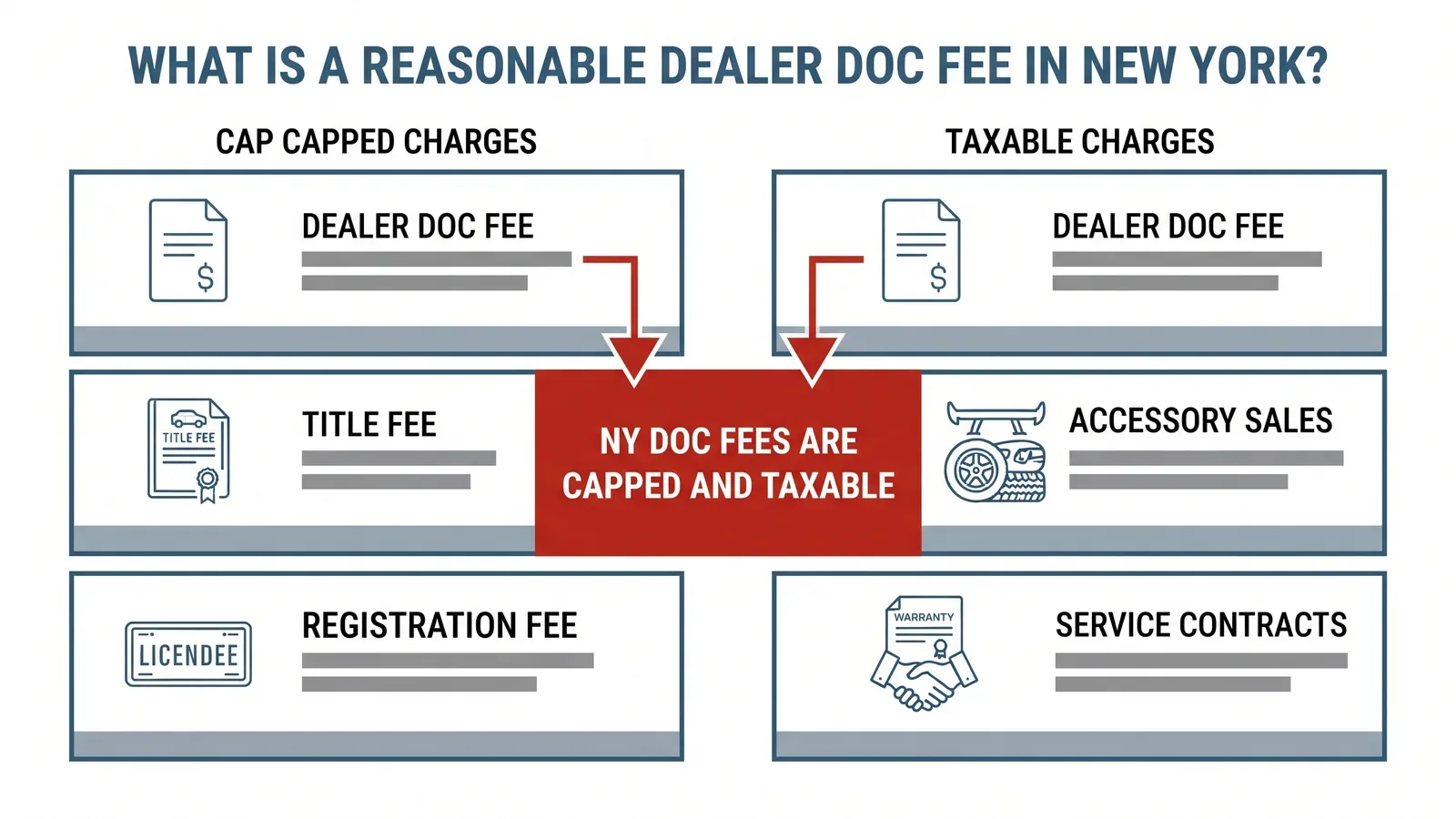
| Line on the order | Cap | Taxable in New York? |
|---|---|---|
| Documentation fee | $175 | No, if separately stated and reasonable |
| Special or distinctive plates | $5 | Collected for the state |
| Title and registration | Set by DMV | No, if the actual amount is stated |
| Dealer preparation | No cap | Yes |
| Advertising charge | No cap | Yes |
| Reconditioning | No cap | Yes |
The right-hand column is the one worth studying, and the next section explains why.
Is a Doc Fee Taxable in New York?
Not if it is handled correctly, and this cuts the other way for uncapped charges. Publication 838 excludes a separately stated, reasonable documentation fee from the taxable receipt. It also excludes DMV fees for registration, title and inspection where the actual amount is stated. According to the New York DMV (2026), the title certificate is $50 and plates are $25, so those figures are checkable against your order.
Dealer preparation fees and advertising charges are a different matter. Publication 838 lists both as amounts the taxable receipt does include. A dealership that trims the doc fee but adds a prep line therefore increases your tax as well as your total. That is the opposite of the savings it looks like.
Ask for the itemized order before you visit. AR Motorsports publishes its Suffolk County inventory and pricing and its Nassau County listings up front.
Can You Negotiate the Doc Fee?
Sometimes, though it is rarely the most productive place to push. Many dealerships charge exactly $175 because that is the ceiling, and some apply it uniformly to every deal as a matter of policy. A dealer is not obliged to reduce it.
The better use of the same conversation is the uncapped lines. Reconditioning and prep charges carry no legal limit and vary by more than a thousand dollars between dealerships on comparable cars. Winning $50 on a capped fee while accepting an unexamined $900 prep charge is a poor trade.
What If the Dealer Is Not Filing Your Paperwork?
This is the condition almost nobody checks, and it is written into the rule. The fee in 15 NYCRR 78.19 is for dealers who aid in securing registrations and titles. It applies where the dealer files the application for a customer who bought the vehicle there. The charge exists because the service does.
So if you are handling your own registration at the DMV, ask what the fee is covering. The answer may be legitimate, since the dealership still prepares documents for a sale it made. It is a fair question, and how a seller responds tells you something either way. Every AR Motorsports listing shows the owner count and vehicle history status before you ask.
Frequently Asked Questions
What is a reasonable doc fee in New York?
Anything at or below $175, which is the ceiling set by 15 NYCRR 78.19 for registration and title assistance. Many dealerships charge exactly that figure because it is the maximum permitted, so treat it as a ceiling rather than a market rate. Below it is possible and occasionally negotiable. Above it is not permitted, and it also fails the tax code's presumption of reasonableness at the same threshold.
Is the New York doc fee cap $175 or something else?
It is $175 under 15 NYCRR 78.19, which took effect on 18 August 2021. Several national guides list New York figures well below that, which does not match either the regulation or common practice here. The same section separately caps the fee for special or distinctive plates at $5. Those two numbers are the only doc-fee amounts New York regulation actually fixes.
Do I have to pay sales tax on the doc fee?
Generally no. New York Publication 838 states that documentation fees are not subject to tax where the amount is separately stated and reasonable. It presumes reasonableness at or below the DMV-permitted figure. DMV title, registration and inspection fees are similarly excluded when the actual amounts are stated. Dealer preparation fees and advertising charges are taxable, so those lines cost more than their face value.
Can a dealer refuse to remove the doc fee?
Yes. The doc fee is a dealer-set charge within a legal ceiling, not something you can decline the way you can decline an add-on. Many dealerships apply it to every transaction as policy and will not make exceptions. What you can do is negotiate the vehicle price or the uncapped charges. Compare written out-the-door totals between sellers rather than arguing about one line.
Why do doc fees vary so much between states?
Because most states do not cap them. Where no ceiling exists, the fee becomes another margin line and can run well into three figures. New York is among the states that set a specific limit by regulation, which is why the number here is predictable. It also means national advice about typical doc fees tells you very little about what belongs on a New York buyer's order.
What is the difference between a doc fee and a title fee?
A doc fee is money the dealership keeps for preparing paperwork, and it is capped at $175. A title fee is money the state charges, currently $50 for a certificate of title, which the dealer collects and forwards. One is a regulated dealer charge and the other is a government cost. They should appear as separate lines, and the DMV amounts should match published rates.
Is a $175 doc fee negotiable on a cheap car?
It is the same ceiling regardless of the vehicle price, which is why it bites hardest at the budget end. On a $4,000 car, $175 is over four percent of the purchase. Some dealerships will reduce it to close a deal and others will not. If it will not move, redirect the conversation to the vehicle price or to any reconditioning charge on the order.
What should I do if the doc fee is over $175?
Ask for a corrected buyer's order before signing anything, and cite the amount rather than the principle. A figure above $175 for registration or title assistance exceeds what 15 NYCRR 78.19 permits. It also loses the tax code's presumption of reasonableness, so the excess may be treated differently for sales tax. If the dealership will not correct it, that is useful information about the rest of the deal.
Are doc fees higher on used cars than new ones?
The cap is the same either way, because the regulation limits the fee for registration and title assistance without reference to the vehicle's age. What differs is proportion. A $175 fee is a rounding error on a $45,000 new car and a meaningful cost on a $5,000 used one. That is why fee scrutiny matters more at the budget end of the market than at the top.
Does the doc fee cover the state inspection?
No, those are separate charges. New York requires an annual safety inspection, and the inspection fee is a state-set amount, not part of the dealer's documentation charge. Publication 838 treats DMV-imposed fees, including inspection, as outside the taxable receipt when the actual amounts are stated. If one line appears to bundle paperwork and inspection together, ask for it to be itemized.
Executive Summary
New York gives "reasonable" a legal meaning rather than leaving it to judgment. Regulation 15 NYCRR 78.19, effective August 2021, caps the dealer fee for registration or title assistance at $175. It separately caps special or distinctive plates at $5. Publication 838 adopts the same threshold for tax. A separately stated doc fee is presumed reasonable, and stays outside the taxable receipt, at or below the permitted amount. Above $175 a dealer is outside both rules at once. The regulation also ties the fee to the dealer actually filing the paperwork. The larger risk sits in uncapped reconditioning, prep and advertising lines, which are taxable and vary widely between dealerships.
What Should You Do Next?
First, find the documentation line on the buyer's order and check it against $175, then check any plate charge against $5. Second, ask which lines are DMV amounts and confirm they match published state rates. Third, turn to the uncapped charges, because reconditioning and prep are where the real variation between two dealers lives.
Most New York dealers charge the full $175. AR Motorsports does not charge a documentation fee at all, and has never required a customer to buy a warranty. You can schedule a test drive and go through the order line by line.
People Also Read
• KBB vs NADA: Which Used Car Value Is Accurate?
About the Author
Angelo writes for the AR Motorsports team in Bay Shore, New York. The indoor showroom at AR Motorsports has served Suffolk and Nassau County since October 2018. Every vehicle comes with a free CARFAX report, so buyers read the history before they commit. AR Motorsports has held a BBB A+ rating since August 2023. The team works with buyers across every credit profile.
Expertise: Used Vehicle Sales, Vehicle History Reporting, Auto Financing, Trade-In and Vehicle Appraisal, Long Island Used Car Market
Connect: Facebook
Disclaimer: This article is for general information only and is not financial, legal, or tax advice. Vehicle availability, pricing, and terms change without notice. Financing is arranged through third-party lenders and is subject to credit approval, and not all applicants qualify. Vehicle history information comes from third-party reports, including CARFAX, and AR Motorsports does not guarantee that any report is complete. Confirm current details with AR Motorsports before making a purchase decision.