



Last Updated: October 2026
A used car dealer fee is any charge a dealership adds to the vehicle price to cover paperwork, preparation or optional extras. Some are capped by New York regulation. Others are set entirely by the dealer. The documentation fee is the one most buyers ask about, and state law limits it to $175 per sale. Knowing which category each line belongs to separates a fair buyer's order from an inflated one.
AR Motorsports has sold used cars in Bay Shore since October 2018, serving buyers across Suffolk and Nassau County. Its inventory starts under $10,000 and runs up from there.
Fees matter more at that price point. A $900 stack of charges is noise on a $45,000 truck. On a $6,000 commuter car it is fifteen percent of the purchase.
Key Takeaways
- The doc fee cap is $175: New York regulation 15 NYCRR 78.19 sets the ceiling, excluding DMV registration, title and inspection fees.
- Tax and title are fixed: The dealer forwards them to the state, so none can reduce them.
- Reconditioning is uncapped: Prep fees have no legal limit in New York, and that is where dealer variation is widest.
- Ask for out-the-door in writing: A written total including tax and fees is the only honest way to compare dealers.
- Your warranty rights depend on mileage: The Used Car Lemon Law sets coverage by mileage band, not by price.
Each point has detail worth understanding before you sign, in the order they come up on the lot.
What Is a Documentation Fee?
A documentation fee covers the administrative work of transferring a vehicle to your name. That means preparing the bill of sale, filing title paperwork and submitting registration to the Department of Motor Vehicles. New York regulates this charge directly. According to New York regulation 15 NYCRR 78.19 (2021), a dealer may charge no more than $175 for assisting with registration or title.
The regulation is specific about what the $175 does not include. It excludes three separate charges: the DMV registration fee, the certificate of title fee, and the state inspection fee. Each appears as its own line on your buyer's order. A dealer showing $175 for documentation plus a distinct registration charge is not double-dipping. A dealer showing $400 for documentation is over the cap.
Are Reconditioning Fees Legal in New York?
Reconditioning fees are legal and have no cap. They cover the work a dealer does to make a trade-in retail-ready. That can include a mechanical safety check, brake or tire replacement, and detailing. Because no regulation limits the amount, two dealers can charge $200 and $1,400 for what is nominally the same work. That gap is the single largest variable in used car fee structures.
Ask what the reconditioning fee actually paid for on the specific car in front of you. A dealer who can name the work, and show it, is charging for something real. A flat reconditioning fee applied identically to every vehicle on the lot is closer to a price increase with a different label. You are entitled to ask for that breakdown before you sign.
Which Used Car Fees Can You Negotiate?
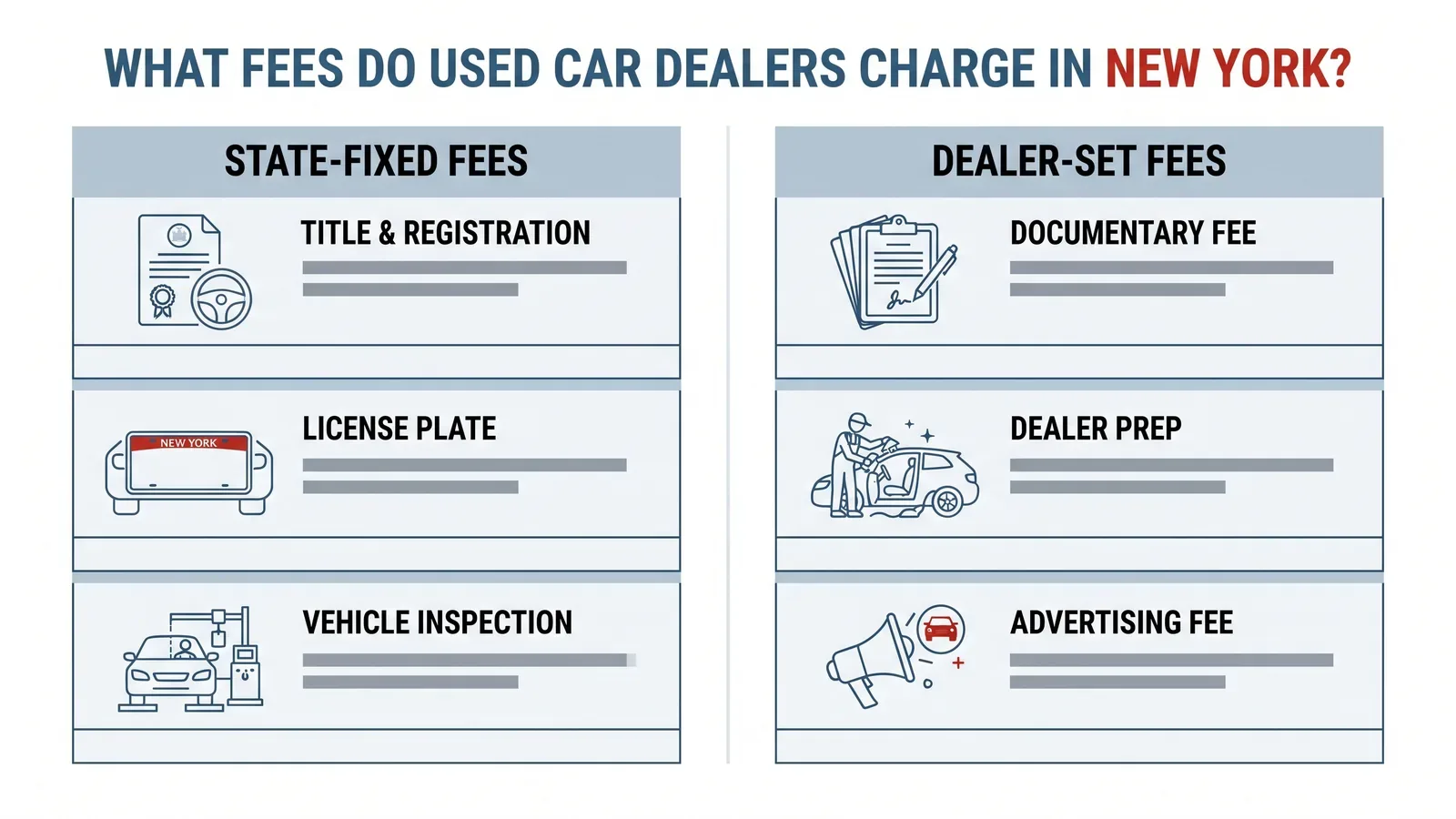
You can negotiate anything the dealer sets and nothing the state sets. Reconditioning, dealer prep, market adjustment, VIN etching and paint protection are all dealer-side charges. Etching the Vehicle Identification Number into the glass is optional, as is every other add-on in that group.
Sales tax, title transfer and registration are collected for New York State. The dealer forwards that money and keeps none of it, so there is nothing to negotiate. The documentation fee sits in between: capped at $175, and reducible if a dealer chooses.
| Charge | Capped by New York law? | Can you negotiate it? |
|---|---|---|
| Documentation fee | Yes, $175 maximum | Sometimes, below the cap |
| Sales tax | Set by state and county rate | No |
| Title and registration | Set by the DMV | No |
| State inspection | Set by the state | No |
| Reconditioning or dealer prep | No cap | Yes |
| VIN etching and other add-ons | No cap | Yes, and you can decline |
The pattern is simple. If the money leaves for a government agency, it is fixed. If it stays, it is negotiable. Tax follows a similar split. According to New York Publication 838 (2012), a separately stated doc fee at or under the permitted amount is not taxable. Dealer preparation fees and advertising charges are.
How Do You Spot an Unfair Fee?
Look for charges that appear after you have agreed a price, and for line items with no service behind them. "Dealer prep" on a car already detailed, or "market adjustment" on a used vehicle, are the most common. Neither is illegal. Both are negotiable, and both should prompt you to ask what you are paying for.
Timing tells you more than the label. A fee disclosed on the advertised price and repeated on the buyer's order is a real cost. One that surfaces during paperwork, after the handshake, is being tested on you. Ask for a revised buyer's order with it removed.
Ask any seller to walk you through the buyer's order line by line. AR Motorsports shows its pricing up front. See the Suffolk County stock and the Suffolk under-$5,000 guide.
What Does the Buyers Guide Have to Tell You?
Every used vehicle offered for sale by a dealer must display a Buyers Guide. This is a federal requirement under the Used Car Rule, and according to 16 CFR Part 455 (1985) it applies to every dealer. CFR stands for Code of Federal Regulations. The form states whether the car carries a warranty and what it covers. It also states plainly if the car is sold as-is.
The Buyers Guide is not a fee document, but it belongs here. A dealer who has not displayed one has skipped a legal step. Read it before you discuss numbers. If the guide says as-is and the salesperson describes a warranty, the written form governs.
What Rights Do You Have Under New York Law?
Your warranty rights depend on the odometer reading at purchase, not the price you paid. According to the New York Attorney General (2026), the Used Car Lemon Law sets coverage in three mileage bands. A car with 18,001 to 36,000 miles carries 90 days or 4,000 miles of coverage. From 36,001 to 79,999 miles it drops to 60 days or 3,000 miles. From 80,000 to 100,000 miles it is 30 days or 1,000 miles.
Whichever limit arrives first ends the coverage. The protected components include the engine, transmission, drive axle, brakes, steering, radiator, alternator, starter and ignition system. The battery is excluded. A dealer is treated as having made a reasonable repair attempt after three tries. The same applies if the car has been out of service for fifteen days on one fault.
How Do You Compare Two Dealers Fairly?
Ask both for the out-the-door price in writing. That figure includes the vehicle price, sales tax, title, registration, the documentation fee and every dealer-added charge. It is the only number that compares two offers, because advertised prices exclude different things at different dealerships.
A written figure also protects you later. If the final contract differs from the quote, you have something to point at. Compare totals, not sticker prices.
Frequently Asked Questions
What is a reasonable dealer doc fee in New York?
Anything at or below the $175 regulatory cap is within the law. Many New York dealers charge exactly $175 because that is the maximum permitted, so treat it as a ceiling rather than a going rate. A lower figure is possible and occasionally negotiable. A figure above $175 for documentation is not permitted at all. Ask the dealer to correct the buyer's order before you sign anything.
Can you refuse to pay dealer fees?
You can decline any dealer-set charge, including reconditioning, dealer prep and add-ons such as paint protection. You cannot decline sales tax, title, registration or the state inspection fee, because those are government charges the dealer only collects. If a dealer treats an optional add-on as mandatory, ask them to show where that requirement is written. Declining is not the same as winning, so be ready to walk.
Are dealer fees taxable in New York?
Mostly not, and this catches people out. Under New York Publication 838, a doc fee is not taxable if it is separately stated and reasonable. It is presumed reasonable at or below the DMV-permitted amount. DMV title, registration and inspection fees are not taxable either. Dealer preparation fees and advertising charges are taxable, so moving cost into those lines raises the tax as well as the total.
What is the difference between a doc fee and a reconditioning fee?
A documentation fee covers title and registration paperwork and is capped at $175 by state regulation. A reconditioning fee covers work to prepare the vehicle for sale, and carries no legal cap in New York. The first is administrative and limited. The second is negotiable and varies widely, sometimes by more than a thousand dollars. That makes reconditioning the line to question first.
Can a dealer add fees after you agree on a price?
A dealer should not introduce new charges once you have agreed terms, and you are not obliged to accept them. Ask for a revised buyer's order showing the figure you actually agreed, then read it line by line before signing. If charges keep appearing during paperwork, that is a reason to pause rather than to sign. Nothing obliges you to complete a purchase on the day you started it.
Is a destination charge normal on a used car?
A destination charge belongs on a new vehicle, where it covers shipping from the factory. On a used car it has no obvious basis, so seeing one should prompt a direct question about what it covers. If the answer is vague, treat it as a dealer-side charge and negotiate it. It is not a government fee, whatever the paperwork calls it.
Does the Used Car Lemon Law cover dealer fees?
No. The Used Car Lemon Law governs mechanical condition and warranty coverage rather than pricing or fees. It gives repair rights on specific components within a window set by mileage at sale. Fee disputes fall outside it. For fee questions the relevant rules are the state documentation cap and the federal Buyers Guide requirement. That covers what the dealer must tell you.
How do you check a fee is legitimate before signing?
Ask for an itemized buyer's order and match each line to a category before discussing the total. Government charges should match published state rates. The documentation fee should be at or under $175. Everything else is dealer-set and open to discussion, whatever it is named. Any line you cannot categorize is one to question, and a dealer who cannot explain a charge has not justified it.
Do fees differ between Suffolk and Nassau County?
The documentation cap and the state fee structure are identical statewide, so regulated charges do not vary between the counties. Sales tax rates differ by county, which changes the out-the-door total on the same car. Dealer-set charges vary by dealership rather than geography. Comparing a written out-the-door total remains the only reliable way to see the difference between two offers.
Should you check the vehicle history before discussing fees?
Yes, because the history affects what the car is worth and therefore what total you should accept. A clean report and a mileage timeline that progresses sensibly give you a firmer basis for the fee conversation. A car with an accident record or a title brand is worth less, whatever the fee sheet says. AR Motorsports includes a free CARFAX report with every vehicle, so the history comes before the numbers.
Executive Summary
New York regulates one used car fee tightly and leaves the rest open. The documentation fee is capped at $175 by 15 NYCRR 78.19, and that cap excludes DMV registration, title and inspection charges. Sales tax, title and registration are fixed by the state and cannot be negotiated. Reconditioning, dealer prep and optional add-ons carry no cap, which is where dealers differ and where your negotiation should focus. Separately, the federal Buyers Guide must disclose warranty status on every used vehicle offered for sale. Ask for the out-the-door price in writing before agreeing to anything.
What Should You Do Next?
Start by asking any dealer for a written out-the-door price, then check the documentation fee against the $175 cap. Next, ask what the reconditioning fee paid for and request the itemization. Finally, read the Buyers Guide before you discuss numbers, so you know whether the car carries a warranty.
AR Motorsports does not charge a documentation fee, and has never required a customer to buy a warranty. You can schedule a test drive and go through the buyer's order line by line.
People Also Read
About the Author
Angelo writes for the AR Motorsports team in Bay Shore, New York. The indoor showroom at AR Motorsports has served Suffolk and Nassau County since October 2018. Every vehicle comes with a free CARFAX report, so buyers read the history before they commit. AR Motorsports has held a BBB A+ rating since August 2023. The team works with buyers across every credit profile.
Expertise: Used Vehicle Sales, Vehicle History Reporting, Auto Financing, Trade-In and Vehicle Appraisal, Long Island Used Car Market
Connect: Facebook
Disclaimer: This article is for general information only and is not financial, legal, or tax advice. Vehicle availability, pricing, and terms change without notice. Financing is arranged through third-party lenders and is subject to credit approval, and not all applicants qualify. Vehicle history information comes from third-party reports, including CARFAX, and AR Motorsports does not guarantee that any report is complete. Confirm current details with AR Motorsports before making a purchase decision.